On this page
What a good class does in the first monthComparing the usual optionsBefore the first classPick the class by what it does in the first month, not by what it's called. "Postnatal" on a schedule means almost nothing. We've seen that word on a yoga class that was mostly breathing and on a bootcamp that had new mothers doing burpees at week seven. Both were called postnatal. Only one of them was.
So here is the short version of our recommendation, and then the longer one.
If you can find a small class taught by someone with a postnatal or pelvic health certification, who asks about your birth before the first session and spends the first weeks on breathing, deep core and hips before adding load, take that one. In person or online, it doesn't much matter. If you can't find that, a reputable online postnatal program plus one visit to a pelvic floor physical therapist beats a generic gym class every time.
Now the longer one.
What a good class does in the first month
Ask the instructor what the first four weeks look like. If the answer is "we ease in," ask again. You want specifics.
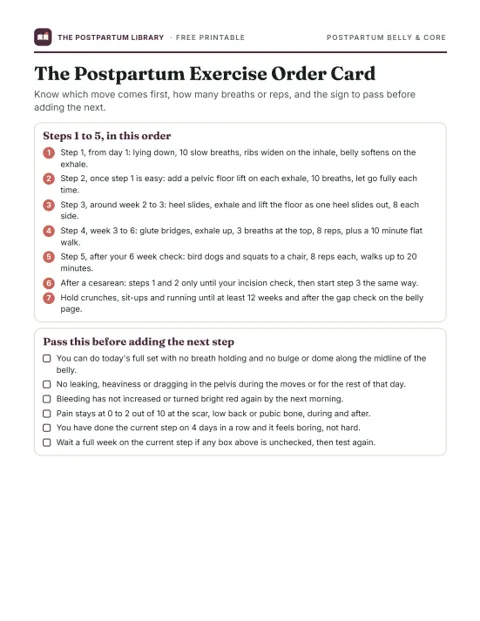
A good answer sounds something like this. Breathing first: exhale on effort, ribs down, belly softening on the inhale instead of bracing. Then the transverse abdominis, the deep muscle that wraps your middle like a wide belt, found by exhaling slowly and feeling the lower belly draw in without the ribs flaring or the shoulders helping. Then pelvic floor, both the lift and the letting go, because a floor that won't relax is as common after birth as one that won't squeeze. Then glute bridges, hip hinges, bodyweight squats to a chair, side-lying leg work, and a lot of walking.
Crunches, sit-ups, full planks, jumping and heavy overhead work do not belong in the first months. Not because they're forbidden forever, but because the connective tissue down your midline and the floor underneath are still remodeling, and both will tell you they're not ready in ways you may not notice during the class itself. Leaking on the drive home. Heaviness by evening. A ridge or cone shape down the center of your belly when you sit up from the mat.
If a class has you doing any of that before week twelve or so, or has you doing it while you can see doming, walk out. You will not get the money back, and it is still worth it.
We wrote out the specific movements, in order, with the cues that matter, if you want to compare a class against something concrete: the postpartum ab exercises that are safe early and the ones that aren't.
Comparing the usual options
Stroller classes. Fit4Mom and similar outdoor groups. Upsides: the baby comes, nobody minds crying, and the social part is real. Downsides: intensity varies wildly by instructor, and a park class can't check your form. Ask how they modify for someone under twelve weeks. If the answer involves "just go at your own pace," you'll be doing lunges with a stroller next to women at month nine, and you'll push to keep up. Everyone does.
Postnatal yoga. Usually the gentlest start, and good for the breathing and the relaxing half of pelvic floor work. The risk is the other direction. Some classes are so gentle you never progress, and some teachers lean on deep backbends and long holds that put pressure on a soft midline. Fine as a first class. Not enough as the only class past month three.
Postnatal Pilates. Often the best fit, because Pilates already lives in the deep core and hip space. But check whether the teacher has actual postnatal training or has just renamed a mat class. The tell is whether they ask about diastasis and leaking before you lie down.
Gym "mom" bootcamps. Sometimes excellent. Often the worst option, because the goal is sweat, and sweat is cheap. Anything advertising fat burning or a shape change in a set number of weeks is selling you something nobody can promise.
Online programs. More variety than any town has, and you can do it at 9 p.m. with the baby on a blanket. Downside: nobody watches your ribs. If you go online, record yourself from the side once a week. Doming and rib flare are easy to catch on video and nearly impossible to feel at first.
Pelvic floor PT-led classes. Rare, often run out of a clinic, and the gold standard when they exist. Search "pelvic health PT postpartum class" plus your city before you search anything else.
The thing that decides which class is right is less the format and more what you're working with. Here is what's actually going on in the belly after pregnancy, because that changes what you need from an instructor.
Before the first class
Get the OK from your OB-GYN or midwife. Most do this at the six-week visit, later after a cesarean, and breathing and short walks before that are generally fine but a class is a different load. If you're leaking, feel heaviness or bulging, have pain with sex, or your midline gap hasn't narrowed to around two finger-widths with some tension underneath it by three months, see a pelvic floor physical therapist first. ACOG recommends them, insurance often covers them, and one visit tells you more than a season of classes.
Stop and call your provider, or 911, for heavy bleeding (soaking a pad an hour), fever, chest or calf pain, a bulge that hurts, or thoughts of harming yourself or your baby. Exercise can bring bleeding back a little; a soaked pad is not a little.
Practical things nobody tells you. Feed the baby right before. Wear a pad to the first few classes even if you've stopped. A nursing bra and a top you can pull down on the floor of a church basement. Tell the instructor your weeks postpartum and how you delivered, every time until they remember. Sit near the door.
And track something. Weeks since birth, reps you did without doming, minutes walked, whether you leaked. Our free core tracker does it in about a minute a day, and a month of entries is exactly what a PT or a good instructor wants to see.
What changes, roughly in order: the breath gets easier, then you can feel the lower belly engage on an exhale, then standing a long time stops aching, then the gap narrows and firms up, then the loose skin and softness shift last and slowest. Nobody can tell you how far or by when. Anyone who does is guessing.
If you want a daily routine to run alongside whatever class you choose, our guide The 10-Minute Mom Pooch Reset lays out the breathing, deep core and pelvic floor work in ten minutes, week by week.
The 10-Minute Mom Pooch Reset
The 12-week program for a stronger core and a firmer belly, 10 minutes a day, with gentle fitness from week 5.
See the plan →Not sure yet? Take the free 2-minute quiz
Educational content from The Postpartum Library. Not medical advice for your specific situation. Get clearance from your OB-GYN or midwife before exercising after birth, and see a pelvic floor physical therapist for leaking, pain or a bulge.