Buy the cheap stuff for the first two weeks and ignore nearly everything else in the "fourth trimester" aisle; the whole useful kit fits in one drugstore bag.
Here's what's actually happening, because the products make more sense once you know. Your uterus is shrinking back toward its normal size over roughly six weeks, and the wound where the placenta attached is bleeding as it heals. That's the lochia: heavy and red the first few days, then pink, then brownish, then a yellowish trickle that comes and goes. If you tore or had an episiotomy, you have stitches in a spot that gets wet every time you pee. Your breasts are filling. Your abdominal wall and pelvic floor have been stretched for months and don't know yet that the baby is out.
So the useful products are for bleeding, for a sore perineum, for your breasts, and for being able to poop without dread. That's the list.
What to have ready
Pads, lots of them, in two sizes. Thick overnight pads for the first days, regular ones for the weeks after. No tampons or cups until your provider clears you; the cervix is still open and the uterus is healing.
A peri bottle. The hospital gives you one, and the angled kind from a drugstore works better. Fill it with warm water and squirt while you pee so the urine doesn't sting the stitches, then squirt again to rinse instead of wiping. Pat dry front to back.
Witch hazel pads, the plain unscented ones. Line them along your pad. Cold on a sore perineum feels better than almost anything, so either buy the instant cold packs made for this or make padsicles: soak a pad with water and a little witch hazel, fold it in foil, freeze. Twenty minutes on, then off. Some women also like a numbing spray with benzocaine for the first days.
Big, cheap, high-waisted cotton underwear. The disposable mesh pairs from the hospital are fine while they last, and after that, buy underwear a size up that you won't mind ruining.
A stool softener. Your provider will likely say docusate is fine, and the first bowel movement after a tear or a cesarean is the thing people remember. Fiber, water, and a stool softener taken from day one, not when you're already stuck. A small step stool under your feet on the toilet helps the pelvic floor relax; a folded towel pressed against the perineum while you go takes the fear out of it.
A sitz bath, the plastic basin that sits on the toilet, or just a few inches of warm water in a clean tub. Ten minutes, a couple of times a day, no soap in the water.
For breastfeeding: lanolin or a plain nipple balm, a few reusable or disposable breast pads, and a soft nursing bra without underwire. You'll leak when the baby cries, when the baby is late to feed, and sometimes for no reason. Cold packs in the bra help with engorgement, as do cabbage leaves if you want to try them, though warmth before a feed and cold after is the simple version.
A large water bottle that you can open one-handed. You'll be thirstier than you expect, especially while nursing.
If you had a cesarean, add a pillow to hold against the incision when you cough, laugh, or stand, and loose high-rise pants that don't hit the scar. Keep the incision clean and dry, pat it after showering, and look at it once a day in a mirror.
Call your provider or 911, not a product page, for bleeding that soaks a pad an hour, a fever, chest or calf pain, an incision or bulge that hurts and gets worse, or thoughts of harming yourself or your baby.
What to skip
Compression garments sold as a fix. A corset-style wrap worn from morning to night squeezes a pelvic floor that's already strained and changes nothing underneath. We've covered the narrower question of soft binders after a cesarean in our postpartum belly band guide, so we won't repeat it here beyond this: short stretches, loose enough to breathe, and it's a comfort tool, not a shaping tool.
Detox teas, "belly" wraps with herbs in them, and anything promising inches. Crash diets. If you're nursing, you need fuel, and cutting hard stalls supply and leaves you wrecked.
Scented wipes and sprays near stitches. Water is enough.
Expensive sitz bath herbs. Warm water does the work.
The $60 "postpartum kit" box. Open the list above, buy the eight things in it, done.
When the real recovery starts
Around six weeks the bleeding tapers, the perineum is mostly healed, and the part that takes longer comes into view: the abdominal wall and pelvic floor. Nothing in a box fixes that. What helps is cheap and slow.
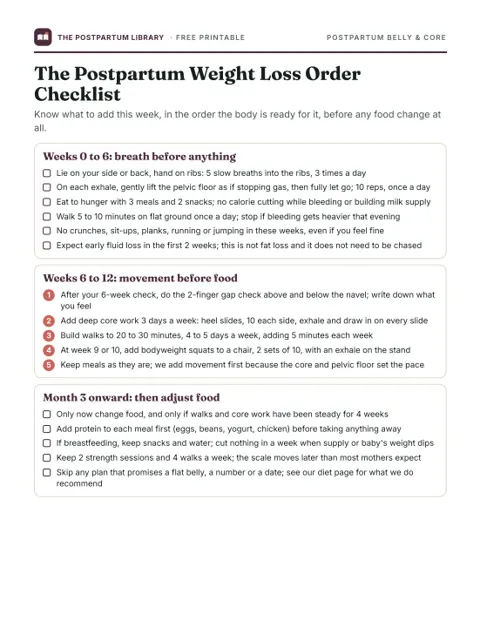
Start with breathing, and do it where you already are: feeding the baby, sitting up in bed. Both feet flat, one hand on the side of your ribs. Inhale and feel the ribs push into your hand. Exhale slowly, as if fogging a mirror, and notice the lower belly flatten a little on its own without you sucking in. Five breaths before each feed is plenty to begin. That's the transverse abdominis waking up, and it's the foundation for everything after.
Add short walks, then longer ones. Add gentle pelvic floor squeezes on the exhale, and just as importantly, practice letting go fully on the inhale.
Walks and the breathing are yours now; the rest waits until your OB-GYN or midwife has looked you over, usually at the six-week visit, and told you exercise is fine. Leave crunches and sit-ups alone in these early months. Lie on your back and try to curl your head and shoulders up and you'll see why: the belly domes up the center, and the linea alba takes a load it isn't ready to hold. Check for a gap above and below the navel with your fingers, and if it's more than two finger-widths or doesn't firm up when you exhale and lift your head slightly, that's worth a visit. See a pelvic floor physical therapist for leaking, heaviness, pain with sex, or a gap that doesn't close. ACOG recommends postpartum care as an ongoing process rather than a single visit, and this is exactly what that visit is for.
Keep track of what you did and how it felt with our free core tracker: https://postpartumlibrary.com/tools/core-tracker
Eggs or yogurt at breakfast, chicken or beans at lunch and dinner, the water bottle refilled a few times, and a nap whenever someone else has the baby: that plain combination changes the belly more than a wrap ever will.
When you're ready for a short daily routine built on that breathing, our guide The 10-Minute Mom Pooch Reset walks you through it in order.
The 10-Minute Mom Pooch Reset
The 12-week program for a stronger core and a firmer belly, 10 minutes a day, with gentle fitness from week 5.
See the plan →Not sure yet? Take the free 2-minute quiz
Educational content from The Postpartum Library. Not medical advice for your specific situation. Get clearance from your OB-GYN or midwife before exercising after birth, and see a pelvic floor physical therapist for leaking, pain or a bulge.