Most of what leaves in the first two weeks is fluid, not fat, so don't read much into the scale early. You'll pee a lot, you'll sweat through the sheets at night, your feet will go back to a size you recognize. That drop is real but it isn't the thing you're asking about.
The part you're asking about is slower, and it has an order to it. We'll walk through the order, then the food part, then the movement part, because the movement part is where we see people get hurt.
At a glance
Weeks 6 to 12: movement before food
- 1
After your 6-week check, do the 2-finger gap check above and below the navel; write down what you feel
- 2
Add deep core work 3 days a week: heel slides, 10 each side, exhale and draw in on every slide
- 3
Build walks to 20 to 30 minutes, 4 to 5 days a week, adding 5 minutes each week
- 4
At week 9 or 10, add bodyweight squats to a chair, 2 sets of 10, with an exhale on the stand
- 5
Keep meals as they are; we add movement first because the core and pelvic floor set the pace
What changes, and when
The uterus takes roughly 6 weeks to go back down. Until it does, the lower belly is firm and sits forward no matter what you weigh. People poke at it and think it's fat. It's an organ.
After that, the abdominal wall is the next thing. It was stretched sideways for months and the connective tissue down the middle got thin. It tightens on its own for a good while, more if you give it something to do (breathing and deep core work, below) and less if you're bracing and holding your breath every time you lift the car seat. The skin is last. It stays loose longer than anybody likes, and it doesn't respond to exercise, only time and genetics.
Fat loss, the actual thing, usually shows up first in the face and arms, then the legs, and the middle last. That's the same for most bodies and it's the reason people say "I lost weight but my stomach looks the same." It will catch up. We can't tell you how much, how fast, or by when. Anyone who does is guessing.
If you're nursing, your body holds onto some fat on purpose, often around the hips and thighs, and some women don't see that shift until they wean. Not all. Some lose steadily while nursing because of the demand. You'll find out which one you are.
Sleep matters more than most people want to hear. Short, broken sleep raises appetite and makes the body hold onto the middle. You can't fix the sleep, we know. But it explains a lot, and it means the scale often moves more in month four than month two without you doing anything differently.
Eating when you're tired and possibly feeding someone else
Don't diet. We mean that plainly. If you're breastfeeding, cutting hard can drop your supply within a week or two, and even if you're not, you're healing a wound the size of a dinner plate where the placenta came off. Your body needs material.
What works is boring. Protein at every meal, including breakfast, including the 3 a.m. toast if you can swap it for something with eggs or yogurt or leftover chicken. Milk is made from water, so keep a bottle wherever you sit to feed and drink it every time. A lot of what feels like bottomless hunger in the first months is thirst plus low protein.
Eat when you're hungry. The hunger of making milk is not something you can override with willpower, and trying to leaves you eating crackers over the sink at 11 p.m. Put real food where you can reach it one-handed. That's most of the strategy.
If you want to track something, track protein and water for a week, not calories. If the numbers are low, fix those two and give it a month before you decide anything else.
Weight loss that happens from this is slow. That's correct. Fast loss in the first months usually means something is off: supply crashing, thyroid, not eating because you're too sad or anxious to bother. If you've lost your appetite entirely, that's a thing to bring up at the 6 week visit, not push through.
Moving without undoing anything
Get clearance from your OB-GYN or midwife before you start anything beyond walking and the breathing work. That's not a formality. They'll check your incision or your tear, your bleeding, your blood pressure. And if you have leaking, a heavy or dragging feeling low in the pelvis, pain with sex, or a gap down the middle of your belly that isn't closing, ask for a referral to a pelvic floor physical therapist. Those don't resolve from willpower and they don't resolve from running.
Separately: heavy bleeding that soaks a pad an hour, fever, chest pain, calf pain, a bulge that hurts, or thoughts of harming yourself or your baby mean you call your provider or 911. That's said once here so you don't have to wonder.
Now the actual movement.
Week one to six: walk, and breathe. Walking can start the day you're home, five minutes on the sidewalk, add a few minutes every couple of days. If you feel heaviness in the pelvis or your bleeding picks up after a walk, you did too much, back off a day.
The breathing is the core work, and it's the thing everyone skips because it doesn't feel like exercise. Lie on your back or sit. Breathe in and let the ribs widen and the belly soften. Breathe out through pursed lips, slowly, and as you do, draw the pelvic floor up (the feeling of stopping gas) and let the lower belly gently pull in. Not a crunch. No bulging outward, no bearing down. 10 breaths, three or four times a day. That's the deep core and the pelvic floor learning to work together again, and it's what makes everything later go better.
Don't do crunches or sit-ups for the first several months. Don't do planks early either. Both push the organs down and out against tissue that can't hold them yet. And skip the waist trainers. A soft wrap for a few hours while you're up and about can feel supportive in the first weeks; a stiff corset all day teaches the muscles to do nothing.
Check your own gap once you're past the first month. Lie on your back, knees bent. Put your fingertips just above the navel, pointing down toward your feet. Lift your head an inch. Feel how many fingers drop into the space between the two sides. Two finger-widths with some tension underneath is common and usually closes with the work above. Three or more, or a soft spot where your fingers sink without resistance, go see the pelvic floor PT.
After clearance, usually 6 weeks or a bit later after a cesarean, add strength. Squats to a chair, bridges, dead bugs, rows with a band, 8 to 12 reps, two or three sets, exhaling on the hard part. Walk more. Impact (running, jumping) waits until you can do all of that with no leaking and no heaviness, which for most people is a few months out, longer than they expect.
ACOG's general guidance is 150 minutes a week of moderate activity once you're cleared. Walking with a stroller counts. Carrying the baby up and down the stairs twenty times a day counts. You don't need a gym.
The pattern we see over and over: the women who do the breathing and the walking in the first weeks, eat enough protein, and wait on impact are the ones whose middles change the most by the end of the first year. The ones who crash-diet and crunch at four weeks are the ones in our office at four months with a bulge and a leak.
If you want the breathing and deep core sequence written out with the reps and the cues, that's what our guide The 10-Minute Mom Pooch Reset is.
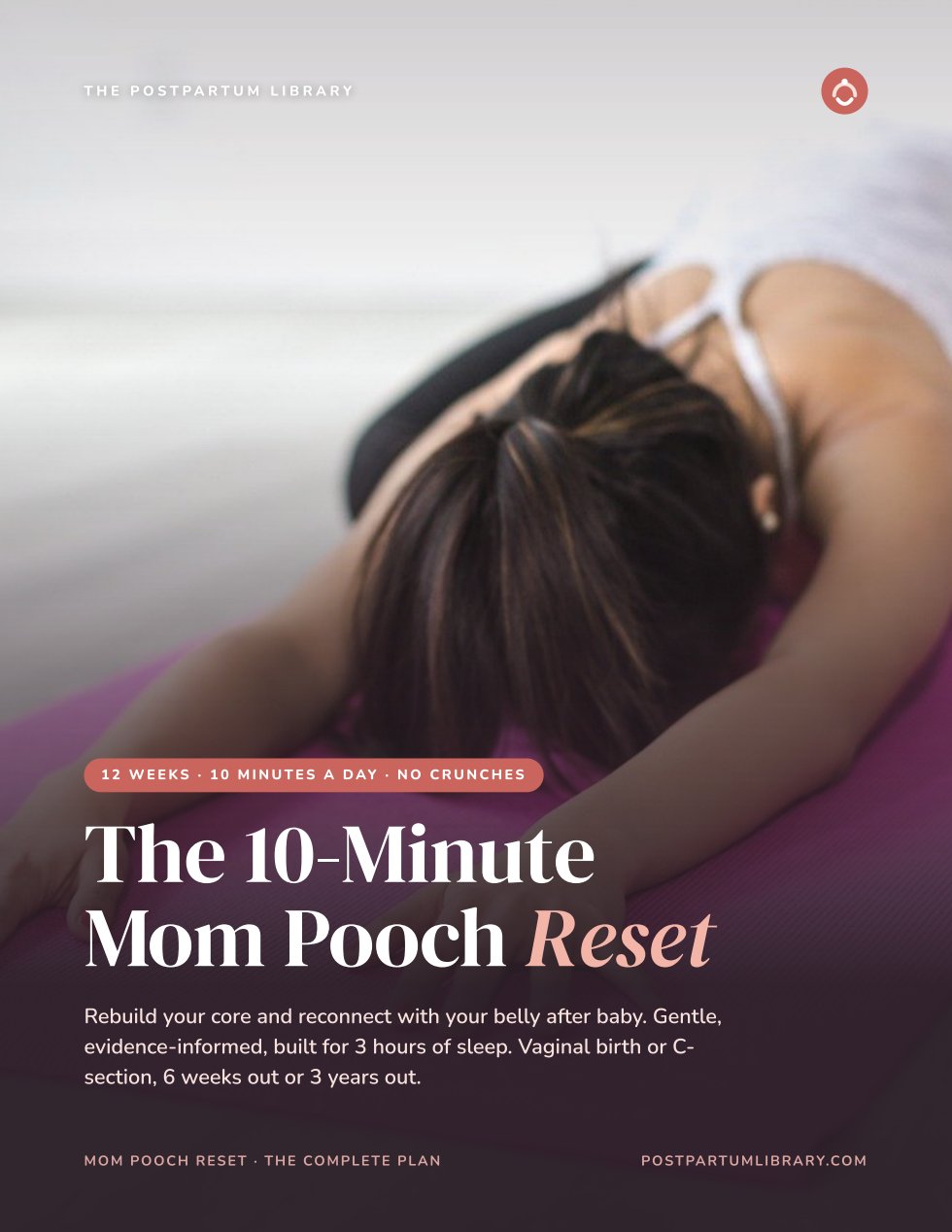
The 10-Minute Mom Pooch Reset
The 12-week, 10-minute-a-day core and belly plan for exhausted moms: the gap check, breath-to-core, three phases, kitchen-counter and naptime routines, food that helps, and 6 printable trackers.
See the plan →Not sure yet? Take the free 2-minute quiz
Educational content from the Mom Pooch Reset team. Not medical advice for your specific situation. Get clearance from your OB-GYN or midwife before exercising after birth, and see a pelvic floor physical therapist for leaking, pain or a bulge.