Four to six weeks for most people, sometimes closer to eight, and it does not taper in a straight line. It gets lighter, then has a day where it looks like it's over, then comes back pink for an afternoon because you carried the car seat up the stairs. That's normal. Knowing the pattern ahead of time is most of what keeps it from scaring you.
The bleeding is called lochia, and it's worth knowing where it comes from. When the placenta detaches it leaves a raw patch on the inside of the uterus, roughly the size of your palm. That patch has to heal over while the uterus shrinks from the size it was at full term back down to something you can't feel from the outside. Lochia is blood, mucus and tissue from that site. It happens after a vaginal birth and after a cesarean, because the wound is inside, not at the incision.
The order it usually goes in
The first three or four days are the heaviest. Bright red, like a very heavy period, with small clots, especially first thing in the morning. The hospital gives you the big pads and the mesh underwear for a reason. Clots smaller than a golf ball in the first days are expected. Blood pools when you're lying down, so standing up after a nap or a long feed can release a gush that feels like a lot. It's not new bleeding, it's what collected.
Afterpains are part of this stage. Breastfeeding releases oxytocin, oxytocin makes the uterus contract, and you'll feel a cramp and often a small rush of blood a minute or two into a feed. That's the uterus doing its job. It's more noticeable with a second or third baby than a first.
By the end of the first week it usually turns pinkish brown and thinner. Weeks two and three are mostly this: brown, watery, sometimes a streak of red. You can switch to regular overnight pads, then regular pads. Still no tampons, no menstrual cup, nothing inside until your provider clears you. The cervix is still closing and the site is still open.
Somewhere in weeks three to six it fades to a yellowish or cream discharge, light enough that a liner handles it. It may stop and restart a couple of times before it's actually done. The restart is almost always brown or pink, not red.
What makes it pick up again
Doing too much. This is the one you can actually control. A return of red bleeding after it had gone brown, in the hours after a long walk, a grocery run, a day on your feet hosting visitors, is your body telling you the site isn't finished. Sit down for the rest of the day and tomorrow. It should go back to brown within a day. If it doesn't, call.
Standing up after lying down, as above. Nursing, as above. The first bowel movements, which is one more argument for a stool softener and a peri bottle.
Change pads often, front to back, and look at them. It feels grim but it's the single best piece of information you have about how healing is going. Rinse with the peri bottle each time you use the bathroom and pat dry. Skip soap on stitches.
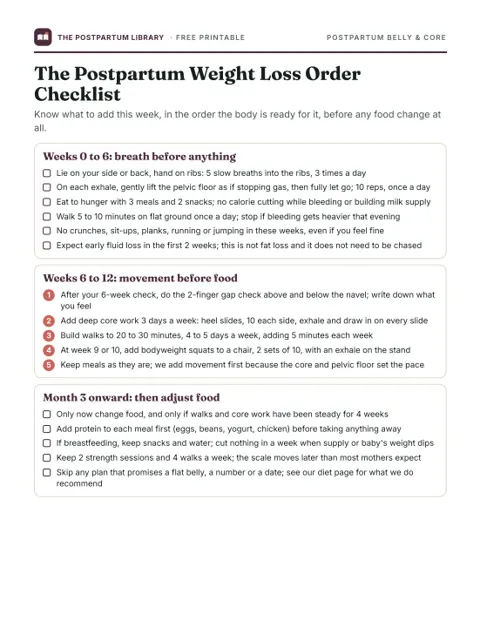
For movement: walking is fine from the first days if you feel up to it, and it helps. Anything more than walking, wait for clearance from your OB-GYN or midwife, and use the bleeding as feedback in the meantime. Breathing work and gentle deep core and pelvic floor contractions can start early with your provider's okay; you'll want somewhere to keep track of what you did and what the bleeding did afterward, which is what our free core tracker is for. If you're leaking urine, feel heaviness or pressure in the vagina, have pain with sex once you've resumed, or feel a gap between the abdominal muscles that isn't closing by the time the bleeding is done, ask for a referral to a pelvic floor physical therapist. Those are common and treatable, and they don't fix themselves by waiting.
Period, or still bleeding?
This is the question that comes up at week six or seven. If you're not breastfeeding, your first period can arrive around six to eight weeks, right as the lochia is ending, so the two can run together. If you're breastfeeding around the clock, periods often stay away for months, though not always, and you can ovulate before the first one. Don't rely on it for contraception.
A period looks like a period: it stopped for a week or more, then red bleeding with cramping that lasts several days and then ends. Lochia that's still going at eight weeks, or that goes brown and then turns bright red and heavy without the stop in between, is something to tell your provider about. What they would check is whether a small piece of placenta or membrane is still inside, which an ultrasound shows, and whether there's an infection in the uterine lining, which they'd look for with an exam, your temperature and how the discharge smells. Both are treatable and both get easier to treat earlier.
Call your provider the same day, or 911 if you can't reach anyone, for any of these: soaking a maxi pad in an hour, two hours in a row; clots bigger than a golf ball after the first days; a fever; discharge that smells foul rather than like a period; feeling faint or your heart racing when you stand; pain or swelling in one calf; chest pain or trouble breathing; a bulge at an incision or in the vagina that hurts; or thoughts of harming yourself or your baby. Heavy bleeding can happen weeks after birth, not only in the first day, and it isn't something to sleep on.
One more thing about timing. ACOG recommends contact with your provider within the first three weeks after birth, not only the six-week visit, so if you have questions about what you're seeing, you don't have to wait. Call the office. Nurses answer lochia questions all day and would rather hear about a pad count than not.
Once the bleeding is down to a liner and you've been cleared, the next thing most people want is a plan for the belly, and our guide The 10-Minute Mom Pooch Reset lays out the breathing and deep core work to start with, in order.

The 10-Minute Mom Pooch Reset
The 12-week program for a stronger core and a firmer belly, 10 minutes a day, with gentle fitness from week 5.
See the plan →Not sure yet? Take the free 2-minute quiz
Educational content from The Postpartum Library. Not medical advice for your specific situation. Get clearance from your OB-GYN or midwife before exercising after birth, and see a pelvic floor physical therapist for leaking, pain or a bulge.