Keep eating, and let the scale be the last thing that moves.
That's the whole trick, not a hedge. Milk is made from what you eat and what you've stored, and your supply responds to a sudden shortfall before the scale does. Cut hard and the first thing you'll notice is a hungrier baby and a headache, not a looser waistband. So the plan below is built to protect the milk and let the weight come off underneath it, which is the only version that lasts past the first month.
A quick word on what's realistic. Some women lose steadily while nursing. Some hold on to the last of it until they wean, and then it goes on its own. Both are normal, and neither says anything about how well you're doing. What usually changes first is fluid, in the first week or two. The uterus takes about six weeks to settle. Fat goes after that, slowly. And the shape of your belly depends more on the connective tissue down the middle and whether your deep core is firing than on your weight, which is why the scale can move while the waistband doesn't.
Eat for the milk, lose from the edges
Don't count calories. Count protein and skipped meals.
Protein at every meal and with your snacks: hard-boiled eggs, a tin of sardines, leftover roast chicken, lentil soup, string cheese, a spoonful of almond butter on whatever is nearest. It carries you through the middle-of-the-night hunger, which is real and not a character flaw.
The skipped-meal count should be zero. Nursing mothers skip meals by accident, because the baby fell asleep on you and the kitchen was in the other room. Stock one-handed food where you sit to feed: a jar of trail mix, dried apricots, clementines, hummus and pita, the boiled eggs you made on Sunday.
Where the loss comes from is the edges. The crusts off the toddler's plate. The pastry that comes with the daily coffee run. The bowl of cereal at ten at night because the day finally stopped. None of that is a moral failing, and all of it is where you trim. Not from meals. We go through the plate-by-plate version in our postpartum weight loss diet guide, so here we'll stick to the nursing-specific part.
Hydration is simpler than people make it. Keep a big water bottle at your nursing spot and drink when you sit down to feed. Thirst is a fine guide; pale yellow urine is a better one. Water won't make you lose weight, but being dehydrated makes you tired, and tired makes you reach for sugar.
Meal-replacement shakes, cleanses, carb-free reboots, fasting windows that run through the morning feeds: no. Not because they're wicked, but because a nursing body treats a steep deficit as a problem to solve, and it solves it by making less milk. If you ever do want a number to eat toward, get it from your provider or a registered dietitian who knows you're nursing, and expect it to sit well above anything a diet app suggests.
Sleep. We know. But a week of broken sleep changes how hungry you are and what you reach for, and no eating plan survives that for long. Take the nap when the baby naps, at least some days. If someone can do one feed with a pumped bottle so you get a longer stretch, let them. Nothing else on this page works as well as sleep does.
Move in this order
Before you do anything past walking and breathing, put the question to your OB-GYN or midwife, usually at the six-week visit, and wait for a yes. While you're in the room, have them check your core and pelvic floor. If you had a cesarean, have them look at the incision too.
Then:
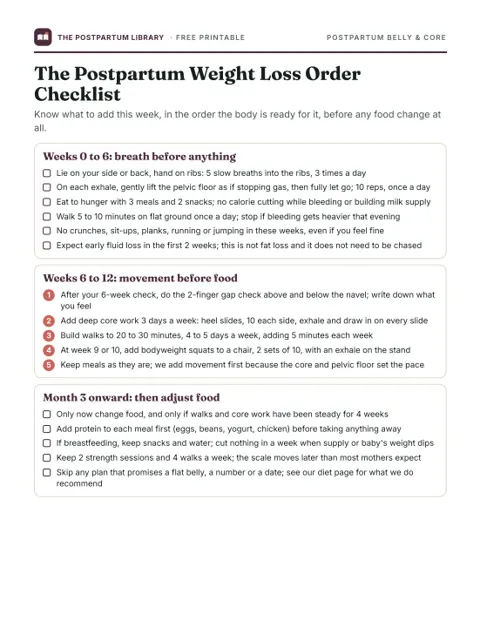
Breathing and the deep core come first, from the first days if you feel up to it. Sitting up in the glider or lying on the couch, take a breath that pushes your ribs out to the sides and your belly forward, then let it out slowly through your mouth. As the air leaves, the lowest part of your belly, the strip between the pubic bone and the navel, should pull in and lift a little on its own. Not a hard brace. Hold that for five slow breaths, let it go, and do that ten times. You can do this while the baby is latched. It is the least impressive exercise you'll ever do and the one that matters most to how your belly feels and looks down the line.
The pelvic floor goes with it: on the exhale, lift as if stopping gas, then fully let go on the inhale. The letting go matters as much as the squeeze.
Walking next. Start with ten minutes with the stroller and add five every few days as long as nothing leaks, aches, or bleeds more afterward. Feed before you go so you aren't walking with full breasts, and wear a sports bra over the nursing bra if you need two. A few weeks in, a daily thirty-to-forty-minute walk is doing more for you than any class would.
Strength after that, once you're cleared and the breathing feels automatic: squats to a chair, hip hinges, rows with a resistance band, carrying the car seat with a braced core instead of a tipped pelvis. Add load slowly. Fast, hard workouts early tend to produce leaking and a stubborn belly, not a smaller one.
Two things to skip for the first months: crunches and sit-ups, which push down on the pelvic floor and bulge the midline, and all-day waist trainers, which hold the belly in for you so your muscles don't have to. A soft support wrap is a separate question. Worn for two or three hours on the afternoons you're standing at the stove or pacing the hallway with the baby, it's fine if it feels good, as long as it comes off before dinner.
If you want somewhere to log the breathing and the walks so you can see the weeks stack up, our free core tracker does that and nothing else.
What to watch
Your body will tell you when you've cut too much. The baby fussing at the breast or feeding longer and still seeming hungry, fewer wet diapers, your own dizziness or a headache that water doesn't fix, feeling cold, hunger that food doesn't touch. Any of those and you eat more for a few days. Supply usually comes back.
Check your midline once, around six weeks. Lying flat with your feet planted and knees up, curl your chin toward your chest just enough to tense the front of your belly, then poke straight down with two fingertips at the navel, an inch above it, and an inch below. A gap of two finger-widths or more that doesn't firm up under your fingers when you exhale, or a gap still there at twelve weeks, is worth a visit to a pelvic floor physical therapist. Same if you leak with a sneeze, feel heaviness or dragging low in the pelvis, or sex hurts. These are common and treatable, and nobody should tell you to wait them out.
And the things that don't wait at all: bleeding that soaks a pad an hour, a fever, chest pain or pain in one calf, a bulge in the belly or near an incision that hurts, or thoughts of harming yourself or your baby. Call your provider, or 911.
The short version: eat enough, eat protein, walk, breathe into your core, sleep when you can, and let the scale be slower than you'd like. If your belly is the part that bothers you most, our guide The 10-Minute Mom Pooch Reset turns exactly this breathing and deep core work into a ten-minute daily routine you can do while the baby naps.

The 10-Minute Mom Pooch Reset
The 12-week program for a stronger core and a firmer belly, 10 minutes a day, with gentle fitness from week 5.
See the plan →Not sure yet? Take the free 2-minute quiz
Educational content from The Postpartum Library. Not medical advice for your specific situation. Get clearance from your OB-GYN or midwife before exercising after birth, and see a pelvic floor physical therapist for leaking, pain or a bulge.