Itching is one of the most reliable signs that an incision is healing, which is cold comfort at two in the morning when you can't scratch it. Here's what's going on and what you can do about it, in the order you'd do it.
The short version: a c-section scar itches because nerves are growing back, new skin is tight and dry, the skin around it was probably shaved, and the whole thing sits in a warm fold under a waistband. Most of that is normal. A few things aren't, and we'll get to those.
Why it itches
The incision cut through skin and through the small nerves that run across the lower belly. Those nerves don't die, they regrow, and regrowing nerves misfire. That's the itch, the tingling, the random zaps, and the odd numb patch above the scar that feels like someone else's skin. The numbness can hang around for months. For some women it's a year before the area feels like theirs again. (If you want the full picture of what was cut and how each layer heals, we go through it in our c-section recovery guide.)
Healing tissue also releases histamine, the same chemical behind a mosquito bite. That's why the itch is worst in the first few weeks, when the most repair is happening.
Then there's the skin itself. New scar tissue has no oil glands, so it dries out and pulls. If you were shaved before surgery, the stubble growing back along the scar line is sharp and it scratches the skin every time you move. And the scar lives in a crease where sweat collects, especially if you're carrying a bit of a shelf of skin over it, which almost everyone is at this point.
One more common one: the adhesive. Steri-strips, the clear dressing, the tape that held the dressing on. Plenty of people react to it. If the itchy rash follows the exact outline of where tape sat, that's probably it, and it clears once the skin is left alone.
What to do, by stage
In the first two weeks, while the incision is still closing, the job is to leave it alone and keep it clean and dry.
Wash it in the shower with water and a mild unscented soap. Don't scrub. Pat it dry with a clean towel, then lift the fold and let air get to it for a few minutes before you dress. If you can't dry it well, a hair dryer on cool works.
Don't scratch. Press flat on the skin beside the scar with the pad of your finger instead. It sounds like nothing. It helps.
Wear underwear that comes up over the incision, not elastic that sits on it. High-waisted cotton, or the mesh ones from the hospital if you still have them. Loose pants. No waistband seam on the line.
A cold pack wrapped in a thin cloth, held near the scar for a few minutes, takes the edge off. Not directly on the incision, and not for long.
Leave the steri-strips alone until they lift off on their own, usually within a couple of weeks. Peeling them early pulls on skin that's barely stuck together.
Skip lotion, oil, vitamin E, and anything scented until the incision is fully closed with no scabs, no open spots, and no drainage. Putting product on an incision that isn't sealed is how you get it irritated or infected.
Once it's closed, which for most women is somewhere around three to four weeks, and once your provider has looked at it, you have more options.
Moisturize. A plain fragrance-free cream or ointment, the kind for eczema, once or twice a day. This alone fixes a lot of the itch because it stops the dry-tight pulling.
Silicone sheets or silicone gel are the one thing with decent evidence for softening and flattening a scar, and they calm the itch for many people while they're on. Sheets go on clean dry skin and get worn most of the day, washed and reused. Gel is easier under clothes. Either is fine. Give it weeks, not days.
If the itch is driving you up the wall, an oral antihistamine is often reasonable, but ask your provider or pharmacist which one, especially if you're breastfeeding. Same with hydrocortisone cream: fine for many people on a closed scar, but ask before you use it on surgical skin.
Don't shave the scar line for a while. If the stubble is the problem, trimming with small scissors is gentler than a razor dragged across fresh scar.
Keep the fold dry through the day. A folded piece of soft cotton tucked under the shelf of skin, changed when it's damp, is a low-tech fix that works. Cornstarch-based powder is fine, talc isn't.
When the itch is telling you something
Call your OB-GYN or midwife, same day, if the scar is itchy and also:
Red and the redness is spreading, or the skin around it is hot or swollen. Draining anything cloudy, yellow, green, or smelly. Opening up anywhere along the line. More painful than it was yesterday instead of less. Or you have a fever.
Blisters or a weeping rash are also worth a call. That's usually a reaction to adhesive or a product, but a provider should see it.
And the ones that don't wait: bleeding that soaks a pad in an hour, fever, chest pain or trouble breathing, pain or swelling in one calf, a bulge near the scar that hurts, or thoughts of harming yourself or your baby. Call your provider or 911.
Separately, if the scar itself is getting thick, raised, and wider, and still itching months out, that can be a hypertrophic scar or a keloid. It's not dangerous, but it responds better to treatment early. Your provider can check and refer you.
The slow part
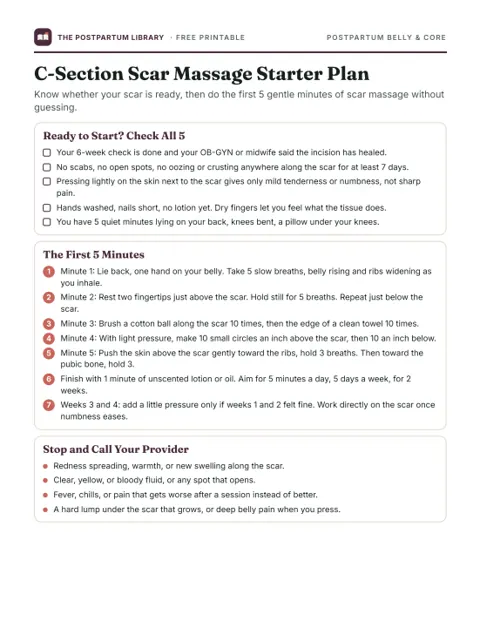
After about six weeks, once you've been cleared, scar massage is the next step. Clean dry hands, a little of the same plain cream, and small circles along the scar with a finger pad, then gentle up-and-down and side-to-side, a few minutes a day. If the scar is too sensitive to touch, start by just resting your palm on it, then a soft cloth, then a slightly rougher one. That retrains the nerves and it's what reduces the zaps over time.
Numbness above the scar is normal and usually fades on its own. If it hasn't changed at all by a year, or if the scar feels stuck down and pulls when you stand up straight, that's a pelvic floor physical therapist question. They work on c-section scars all the time, and the same visit covers leaking, heaviness, pain with sex, or an abdominal gap that isn't closing.
If you want to keep track of what you're doing each week, our free core tracker at https://postpartumlibrary.com/tools/core-tracker has a spot for scar work alongside breathing and deep core.
For the belly above the scar, the one that itches when it rubs against it, our guide The 10-Minute Mom Pooch Reset walks through the deep core and breathing work that goes with scar care.
The 10-Minute Mom Pooch Reset
The 12-week program for a stronger core and a firmer belly, 10 minutes a day, with gentle fitness from week 5.
See the plan →Not sure yet? Take the free 2-minute quiz
Educational content from The Postpartum Library. Not medical advice for your specific situation. Get clearance from your OB-GYN or midwife before exercising after birth, and see a pelvic floor physical therapist for leaking, pain or a bulge.