On this page
What changes with each oneThe questions to ask before the next oneRecovering well between themThere isn't a number. No guideline from ACOG or anyone else says "three and you're done," and plenty of women have had four, five or six cesareans and gone home fine. What exists instead is a risk that climbs a little with each surgery, and a point where your own surgeon starts saying "I'd rather not" based on what they saw the last time they were inside you.
So the real answer is: it depends on your belly, not on a rule. Here's what goes up, what to ask, and what to do between babies if you want more.
What changes with each one
Every cesarean leaves a scar on the uterus and a layer of scar tissue in the abdomen. The scar on the uterus is the part everyone worries about, but it's usually not the thing that ends a cesarean career.
The thing that ends it is the placenta. With each prior cesarean, the odds go up that in the next pregnancy the placenta implants low over the old scar (placenta previa) or grows into the scar itself (placenta accreta spectrum). Accreta is the one obstetricians lose sleep over, because the placenta won't let go after birth and the fix is often a hysterectomy done in a hurry with a lot of blood loss. The large study most providers are thinking of when they talk about this was published in Obstetrics & Gynecology by Silver and colleagues, following women through repeat cesareans, and the pattern was clear: the risk stays low through the first couple of surgeries and rises more steeply from the third and fourth on.
The second thing is adhesions. That's the scar tissue inside the abdomen that glues the bladder, bowel and uterus to each other and to the wall. Adhesions make each surgery slower, make the bladder harder to keep out of the way, and raise the chance of a nick to it or to the bowel. They also make the incision itself longer to get through. Nobody can predict how much you'll form. Some women have almost none after three; some have a dense sheet after one.
Third: the cumulative recovery. Each cesarean is abdominal surgery on an abdomen that has already been cut, and the core and pelvic floor have to rebuild from a slightly lower starting point each time. That part you can actually do something about, which we'll get to.
What does not reliably get worse with count is the scar on the skin. Surgeons generally cut through the same line and remove the old scar as they go.
The questions to ask before the next one
If you're deciding whether to have another baby after one or more cesareans, this is the conversation to have with your OB-GYN or midwife before you conceive, not at the first prenatal visit. Bring a list.
Ask what kind of incision was made on the uterus. The common one is a low transverse cut, which is the stronger kind. A vertical cut on the uterus (sometimes done for very early or urgent deliveries) changes the advice about labor next time and about timing. You can't tell from your skin scar. It's in the operative report, and you're entitled to a copy.
Ask what they saw. Dense adhesions, a thin lower uterine segment, a bladder that was stuck down, a lot of bleeding: these are written in the report and they are the real basis for "I'd be comfortable with one more" versus "I'd think hard about it." A surgeon who says "you shouldn't have more" owes you the specific reason.
Ask about spacing. Most guidance lands on waiting a year and a half or so from delivery to the next conception, and the reason is scar strength and your own recovery, not arbitrary caution. Shorter gaps raise the risk of the uterine scar separating in a later labor.
Ask whether a trial of labor is on the table. After one low transverse cesarean, many women are candidates for a planned vaginal birth, and a successful one takes a surgery off your total. After two, fewer hospitals will offer it. It's a legitimate question even if the answer is no.
And if you do go into another pregnancy, the anatomy scan around the middle of it is where they check placenta location. If it's low or over the scar, you'll likely be referred to a hospital with a maternal-fetal medicine team and a blood bank ready, and delivery will be scheduled a few weeks earlier than usual. That's not a sign something went wrong. It's the system working.
Recovering well between them
This is the part that's yours.
Every cesarean you recover from thoroughly puts you in a better position for the next one, and the better position is mostly about the deep core and the pelvic floor, not about how flat anything looks.
Start with breathing in the first days, lying on your back or propped up: a slow breath in that lets the ribs widen sideways, then a longer breath out while you gently draw the lower belly in and lift the pelvic floor, the sensation of stopping gas. Ten breaths, three or four times a day. It hurts near the incision at first, so keep the effort small. You're reconnecting the brain to muscles that were cut through and stretched, not training them.
Walk. Short and often beats long and once. Across the house the first days, around the block by the second week if you feel up to it, adding a few minutes at a time.
Get clearance from your OB-GYN or midwife before you do more than that, usually at the six week visit, and tell them if you're leaking urine, feel heaviness or dragging in the pelvis, have pain with sex, or can fit more than two finger-widths between the two halves of your abdominal muscles above the belly button when you lift your head. Those are reasons to see a pelvic floor physical therapist, and a referral is a normal thing to ask for after a cesarean even when nothing feels wrong.
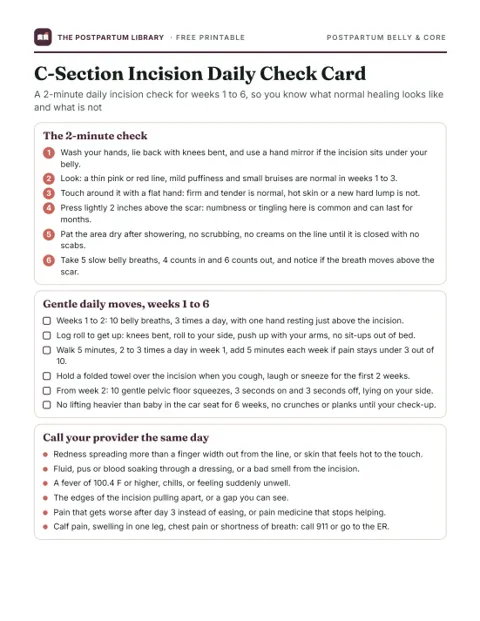
No crunches or sit-ups in the first months. Deep core work first: breathing with the belly draw, then heel slides and knee drops on your back, then standing exercises that make the core hold you steady. We keep a simple free log for this if you want one place to record what you did and how the incision and belly felt afterward: the core tracker.
Protein at every meal, water within reach wherever you sit to feed, and as much sleep as the baby allows. If you're nursing, don't diet hard; your body is doing two jobs and the belly comes in as the uterus shrinks and the core comes back online, not from restriction.
Two practical notes, because they come up every time. Low back pain is common after a cesarean, partly from the belly not yet holding you up and partly from feeding posture, and there are specific things that help: back pain after a c-section. And people want to know when they can drive again, which is about being able to brake hard without hesitating, not about a date on the calendar: driving after a c-section.
Call your provider or 911 for bleeding that soaks a pad an hour, a fever, chest pain, pain or swelling in one calf, a bulge near the incision that hurts, or any thought of harming yourself or your baby. Those don't wait for office hours.
As for the actual number: we've answered the question the way your surgeon will, which is that there isn't one, only a conversation that gets more careful each time. Have it early, get your operative report, space the pregnancies, and rebuild the core properly between them. That's as much control as anyone has over it.
If you want a short daily routine for the deep core after cesarean, our guide The 10-Minute Mom Pooch Reset walks through it one step at a time.

The 10-Minute Mom Pooch Reset
The 12-week program for a stronger core and a firmer belly, 10 minutes a day, with gentle fitness from week 5.
See the plan →Not sure yet? Take the free 2-minute quiz
Educational content from The Postpartum Library. Not medical advice for your specific situation. Get clearance from your OB-GYN or midwife before exercising after birth, and see a pelvic floor physical therapist for leaking, pain or a bulge.