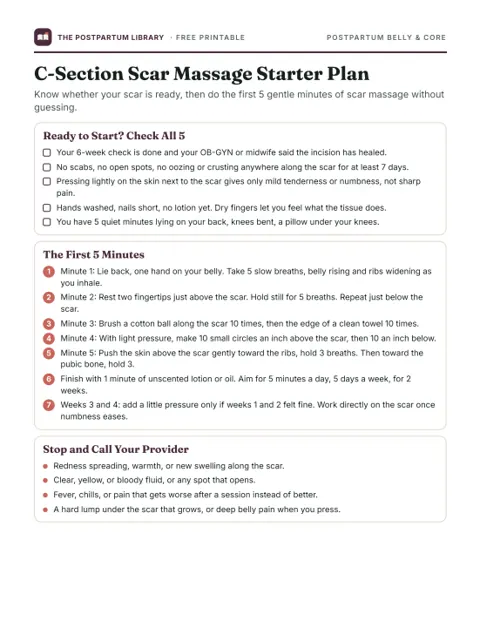
Not yet, if it's still scabbed or weeping anywhere along the line. The short version of the rule: scar massage starts once the incision is fully closed, dry, and your OB-GYN or midwife has looked at it and cleared you to touch it with some pressure. For most people that lands somewhere around 6 weeks, sometimes 8. It is a one-time question at your postpartum visit, so ask it there.
The reason to bother at all is that a cesarean scar runs through skin, fat, and the fascia over the abdominal wall, and as it heals those layers can glue to each other. You feel that as a stripe of skin that doesn't slide, a numb patch, a tug when you stand up straight, or the shelf of tissue that sits over the top of the scar. Massage doesn't remove the scar. It teaches the layers to move independently again, which changes how the whole lower belly feels and looks when you move.
It takes a few minutes a day. The hard part is remembering, not the technique.
Before you touch it
Wash your hands. Lie on your back with your knees bent, or sit propped up on pillows so your belly is soft. Standing makes the abdominal wall tense, and you want it slack.
Look at the scar in good light. You're checking for anything open, any pinhole that leaks, any redness that spreads beyond a finger-width from the line, or a raised hard ridge that's getting bigger. Any of those, skip the massage and show your provider. Fever, drainage, a bulge near the scar that hurts, heavy bleeding that soaks a pad in an hour, chest or calf pain, or thoughts of harming yourself or your baby are not wait-and-see problems: call your provider or 911.
Skip lotion for most of this. You need grip. Lotion makes your fingers skate across the surface instead of moving the tissue underneath. A tiny bit at the very end, if the skin is dry, is fine.
The steps
Work through these in order. Most people spend a week or two on each stage before adding the next one, and keep the earlier stages in the routine. Five minutes total is plenty.
- Desensitize. If the area is numb or weirdly electric, start here and stay here as long as it takes. Stroke across the scar and the skin an inch above and below it with a cotton ball, then a washcloth, then your bare fingertips. Light contact, 1 to 2 minutes. The nerves were cut and are regrowing, and they need input to recalibrate. Some numbness never fully leaves. A lot of it does, slowly, over a year.
- Move the skin around the scar, not on it. Put the pads of two or three fingers about two finger-widths above the scar. Press enough to catch the skin, then move it in slow circles, 10 in each direction. Repeat below the scar. Then do the same with up-and-down strokes and side-to-side strokes, sliding the skin rather than rubbing across it. This is where you'll notice spots that move less. Spend extra time there.
- Work directly on the line. Same finger pads, same pressure. Small circles along the entire length of the scar, left to right, then right to left. Then short strokes across the scar, perpendicular to it, as if you were trying to push the skin on one side over the top of the other. Ten strokes each way. Then strokes along it, end to end.
- Lift and roll. Pinch a section of the scar between your thumb and index finger, including the skin on either side, and gently lift it away from your body. Hold for 3 breaths. Roll it a little between your fingers, then move along to the next section. Early on some parts won't lift at all. That's the glued part. Don't force it.
- Press and hold. Find the stuckest spot. Press into it with two fingers, enough to feel resistance but not sharp pain, and hold for 30 seconds while you breathe slowly, letting your belly rise and fall under your hand. Repeat on the next spot. Later you can add a small stretch: hold the tissue and let the skin pull in one direction, then the other.
That's it. Pressure the whole way through should feel like a firm, slightly annoying tug. Pulling is fine. Burning, sharp, or stabbing pain is not, and bleeding or a reopened edge means stop and call.
If you'd like a place to log the days you actually did it, our free core tracker at https://postpartumlibrary.com/tools/core-tracker has a line for scar work alongside breathing and deep core reps.
What usually changes
Weeks 1 and 2 of massaging: the skin above the scar starts to slide a few millimeters further than it did. The numb band may get tingly, then prickly, then more normal. That's a good sign, not a bad one.
Weeks 3 through 8: the lift-and-roll gets easier along more of the length. The tug when you stand tall or reach overhead fades. If there's a dip where the scar sits lower than the tissue around it, it often softens as the fascia lets go of the skin.
Months 3 through 12: the shelf of tissue over the scar sits a little flatter, mostly because the skin isn't anchored down anymore. Whatever fat is there is still fat. Massage doesn't change that, and neither does anything you'll find in a "get rid of the C-section pooch" video. What changes the overhang is the slow stuff: deep core and pelvic floor rehab, walking, sleep when you can get it, enough protein and water, and time. We walk through the rest of that timeline in what a cesarean recovery actually looks like over the first year.
Keep going for at least 3 months. Scar tissue keeps remodeling for a year or more, so there's no deadline you've missed if you're reading this at 10 months.
A few things people ask us. Silicone strips are a reasonable thing to ask your provider about for the surface look of the scar; they don't replace the mobility work underneath. Keep the scar out of direct sun for the first year, or cover it, because it darkens easily. Scar massage is not a core exercise, so no crunches or sit-ups to "help it along" in these first months. And you can massage while breastfeeding, while pregnant again, and years after the birth. Old scars move too, just slower.
If the scar still won't lift after a couple of months of daily work, if you have pain with sex, leaking, a heavy feeling in the pelvis, or a gap down the middle of your belly that doesn't close, that's a pelvic floor physical therapist's job. They do this exact work with their hands, in a 45-minute visit, and they'll check the things you can't check yourself, like whether the deeper layers are moving.
If you want the daily core routine that pairs with this, our guide "The 10-Minute Mom Pooch Reset" lays it out in order, scar work included.
The 10-Minute Mom Pooch Reset
The 12-week program for a stronger core and a firmer belly, 10 minutes a day, with gentle fitness from week 5.
See the plan →Not sure yet? Take the free 2-minute quiz
Educational content from The Postpartum Library. Not medical advice for your specific situation. Get clearance from your OB-GYN or midwife before exercising after birth, and see a pelvic floor physical therapist for leaking, pain or a bulge.