Under an hour, usually, and most of that hour comes after the baby is already out.
That's the short answer. The longer one depends on which clock you're asking about, because there are at least three: the time from walking into the OR to being wheeled out, the time from the first incision to the baby, and the much longer stretch after, which is the one nobody tells you to plan for.
In the room
For a scheduled cesarean, you walk in. That surprises people. You climb onto a narrow table on your own, sit on the edge with your back curved, and the anesthesiologist places the spinal. That part takes a few minutes of actual needle work, maybe ten to twenty minutes from sitting down to lying flat and numb. You'll feel a warm flush spread down your legs and then nothing from the ribs down. Your legs get heavy in a way that is strange to watch someone else move.
Then prep. A catheter goes in once you can't feel it. Your belly gets scrubbed with antiseptic that is cold and usually orange or brown. A drape goes up at chest height so you can't see the field. Your arms may be laid out to the sides on boards. Someone puts squeezing cuffs on your calves. The anesthesiologist tests with ice or a pinch and asks whether it's sharp or dull. All of that is another ten or fifteen minutes.
The surgery itself starts fast. Skin, a layer of fat, the fascia, the muscles pushed apart (usually not cut), the peritoneum, then the uterus. In an uncomplicated first cesarean the baby is out within about five to fifteen minutes of the skin incision. You don't feel cutting. You feel pulling, pressure, sometimes a strong tug that rocks you on the table, and the moment they press on the top of your belly to help the baby's head out. People describe it as someone rummaging. That's accurate.
Then the cord, the first cry, and if the baby is well and the OR allows it, skin to skin on your chest with the drape still up. Then the placenta, which you won't notice.
Closing is the long part. The uterus is stitched in one or two layers, the fascia is sutured, the skin is closed with staples, glue, or a running stitch under the surface. This is thirty to forty-five minutes, and it feels longer because the exciting part is over and you're cold, shaky, and possibly itchy from the medication in the spinal. The shaking is normal. The nausea is common and they can treat it.
Total: forty-five minutes to an hour and a bit, door to door, for a straightforward case.
Things that add time: twins, because there are two to deliver, two cords, and twice the checking. A breech baby who has to be brought out feet first with some maneuvering. A baby wedged deep in the pelvis after hours of pushing, who has to be eased back up before coming out. Bleeding that needs attention before closing can start. A thick layer of tissue to get through and then close neatly. A tubal ligation done at the same time. A surgeon who closes slowly and well. None of these mean something went wrong.
An emergency cesarean runs on a different clock. The benchmark hospitals train to is thirty minutes from the decision to the incision, and when the baby's heart rate is the reason, it's often much faster than that. If there's no working epidural, you may go under general anesthesia and the baby can be out within a few minutes of the first cut. You'll wake up in recovery with a baby already born and a vague memory of a mask. That's its own kind of hard, and it's worth telling your provider later that you want to walk through what happened.
The next day or two
Recovery room is an hour or two. They check your bleeding by pressing on your uterus, which hurts, and they wait for the spinal to wear off enough that you can wiggle your toes. Then a postpartum room.
The catheter usually comes out within the first day. The first time you stand is the worst moment of the whole thing: everything inside feels like it's dropping, and you'll walk bent over like you're protecting a wound, because you are. Walk anyway, slowly, the same day or the next morning. It's the best thing for the gas pain that lodges under your right shoulder, and it lowers your clot risk.
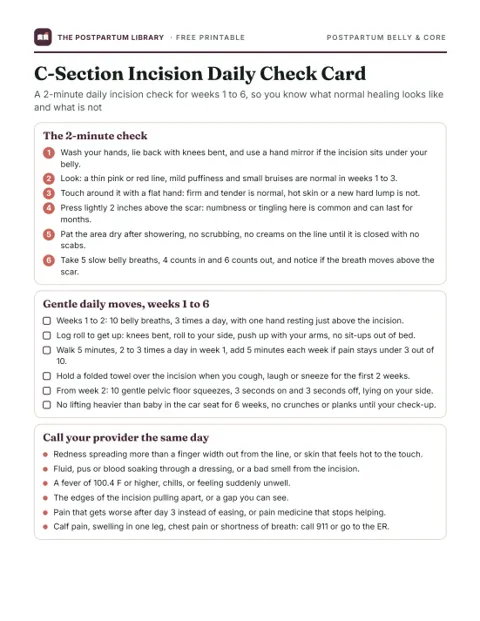
Hold a pillow against the incision when you cough, laugh, or sneeze. Roll to your side and push up with your arms to get out of bed instead of sitting straight up. Keep ahead of the pain medication rather than waiting until it's bad.
Most people go home after a few days. Incision care is boring on purpose: keep it clean and dry, pat it after a shower, no soaking, no creams unless told. Staples come out around the end of the first week, often at an office visit.
This is where the warning belongs. Call your provider or go in for heavy bleeding that soaks a pad in an hour, a fever, redness or pus or opening at the incision, chest pain, calf pain or swelling in one leg, a bulge near the scar that hurts, or thoughts of harming yourself or your baby. Call 911 for chest pain or trouble breathing. Don't wait to see if it settles.
The slow part
The skin looks healed at two weeks. The deeper layers are still knitting for weeks after that, which is why the rules last longer than the scar looks like it needs them.
Lifting: nothing heavier than the baby for the first several weeks. Stairs are fine, slowly. Driving is usually a question of whether you're off narcotics and can slam the brake without flinching, which for many people lands around the second week, but the rule is your provider's. We've written out what to check before you get behind the wheel at driving after a c-section.
Back pain is common in this stretch, partly from the spinal site and mostly from guarding the incision and feeding a baby in bad positions. Back pain after a c-section covers what helps and what's worth mentioning at a visit.
Exercise waits for clearance, usually at the six-week visit, though you can start before that with what doesn't strain the incision: slow breathing into the ribs and belly, gentle transverse abdominis engagement on the exhale, and pelvic floor contractions with a full release after each one. No crunches, no sit-ups, no planks in the first months. The core tracker lets you log a few minutes a day so you can see it add up. A few things mean it's time to see a pelvic floor physical therapist rather than wait it out: a dribble of urine when you sneeze or hoist the car seat, a dragging or bulging sensation low in the pelvis, sex that hurts once you've been cleared for it, or a soft spot down the middle of your belly two or three finger-widths wide that's no narrower at twelve weeks than it was at six. Your OB-GYN or midwife can write the order. A cesarean doesn't spare the pelvic floor; the pregnancy already did the loading.
If you're already wondering about the next one, we answered how many c-sections you can have separately, because the answer is mostly about what the scar looks like next time.
So: an hour on the table, a few days in the hospital, several weeks of protecting the incision, and months of the quiet rebuilding that nobody schedules. The surgery is the fast part.
Once your provider has signed off and you want something to do with those ten minutes a day, The 10-Minute Mom Pooch Reset walks through the breathing, transverse abdominis and pelvic floor work in order, with the cesarean modifications marked.

The 10-Minute Mom Pooch Reset
The 12-week program for a stronger core and a firmer belly, 10 minutes a day, with gentle fitness from week 5.
See the plan →Not sure yet? Take the free 2-minute quiz
Educational content from The Postpartum Library. Not medical advice for your specific situation. Get clearance from your OB-GYN or midwife before exercising after birth, and see a pelvic floor physical therapist for leaking, pain or a bulge.