You're allowed to have one. That surprises people, because a cesarean sounds like something that happens to you rather than something you take part in, but a fair amount of the day is negotiable if you bring it up at a prenatal visit instead of on the table. Nobody reads a two-page document while they're scrubbing in. What works is a short set of requests you've already cleared with your OB-GYN or midwife, on one side of a page, with a copy in your support person's pocket.
So the short version: ask early, keep it to one page, and make sure the person standing next to you knows what's on it.
Here's what goes on it.
In the operating room
Most of these fall under what hospitals call a family-centered or "gentle" cesarean. Not every hospital offers all of it, and in an emergency none of it applies, so ask what's available where you're delivering.
Anesthesia. For a planned cesarean you'll almost always get a spinal, sometimes an epidural if you already have one in place. You're awake. General anesthesia is for emergencies or when a spinal can't be placed. If you're anxious about being awake, say so; the anesthesiologist can give you something for nausea and shakes, and they'll tell you what you'll feel (pressure and tugging, not pain).
Arms. Some hospitals strap one or both arms down. You can ask to have at least one free so you can touch the baby.
The drape. You can ask for it to be lowered at the moment of birth, or for a clear drape, so you see the baby come out. Ask whether you want the surgical team to announce the sex or let your partner do it. Ask for the room to be quiet at the moment of birth if you'd like that, or for your own music.
Delayed cord clamping. ACOG recommends a delay of at least 30 to 60 seconds for healthy term babies, and that applies to cesareans. Ask if it's standard on your unit.
Skin-to-skin in the OR. If the baby's stable, many hospitals will put the baby on your chest while they close. If you're shaky or nauseated, your partner can do it. Ask for newborn procedures (weight, eye ointment, vitamin K) to wait until after that first hold.
Closure. Ask whether your surgeon uses dissolvable sutures or staples for the skin, and if staples, when they come out. Ask about the dressing and when you can shower.
One request we'd skip: vaginal seeding (swabbing the baby with vaginal fluid). ACOG doesn't recommend it outside of a research study, and most hospitals won't do it.
The first two days
A lot of hospitals now follow an Enhanced Recovery After Cesarean protocol. You don't need to know the acronym, but you should know what to expect, because it's faster than most people think.
Pain. Ask for scheduled acetaminophen and ibuprofen rather than waiting until it hurts, with opioids only on top if needed. Ask for a stool softener from day one. Ask whether they'll give you an abdominal binder; some units do, some don't, and it's fine either way for the first week or two as support when you get up. It's not a waist trainer and shouldn't be worn all day for months.
Eating and drinking. You'll likely be allowed clear liquids within hours and food the same day. Chewing gum is sometimes offered to get the bowels moving. Say yes.
The catheter comes out somewhere around 6 to 12 hours after surgery. Once it's out, a nurse will want you standing, then shuffling to the door and back. The first time you go from sitting to upright you'll want to fold forward over the incision. Stand all the way up anyway; it's less sore over the next few days if you do. To get out of bed: lower the rail, swing both legs to the edge, push up through your hands, and keep a folded pillow within reach to press against your belly for sneezes.
Feeding the baby. Side-lying, or a firm pillow across your lap, keeps the baby's weight off the incision. Ask for a lactation visit before you leave if you're breastfeeding, since cesarean and spinal medications can delay milk coming in by a day or so.
Visitors. Put a limit on the plan. Two days is not a lot of time to learn to sit up, walk, feed, and sleep.
Going home. Ask what the discharge criteria are (usually eating, walking, passing gas or stool, pain controlled on oral meds) and what your incision should look like at a week.
The weeks after
This is the part most birth plans leave off, and it's the part you'll live in.
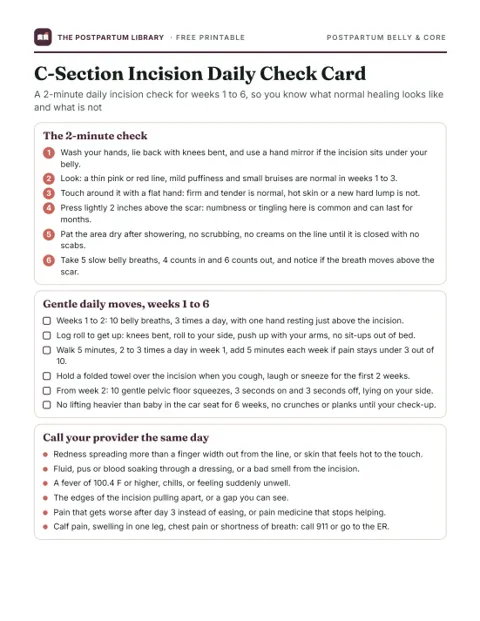
In the first week a lap of the house counts. By the second you can probably manage the end of the block and back, slowly, with the stroller for something to lean on. Somewhere around four to six weeks a 20 to 30 minute walk stops being a project. That's the whole exercise plan until your OB-GYN or midwife clears you for more, usually at the six-week visit. Before then, the only core work worth doing is breathing. Prop yourself against the headboard, or do it in the chair while the baby feeds, rest a palm just below the navel, and let a long exhale through pursed lips run on until the lower belly draws in by itself. Ten of those, a few times a day. That's it. No crunches, no sit-ups, no planks for the first few months.
If you want somewhere to log those ten breaths and the walks so you can see them add up, our core tracker is free.
Your back will likely complain before your incision does, from the hours of feeding hunched over a baby. We cover why and what helps in back pain after a c-section.
Driving is its own question, and the answer is less about a calendar date than whether you can brake hard without flinching. Our page on driving after a c-section walks through how to test that.
And if this is your second or third cesarean, or you're already thinking about the next pregnancy, it's worth reading how many c-sections you can have before you talk to your provider about future plans.
Two things to put on the plan for yourself, not the hospital. First, call your provider or 911 for heavy bleeding (soaking a pad an hour), a fever, chest pain or trouble breathing, calf pain or swelling in one leg, a bulge near the incision that hurts, or thoughts of harming yourself or your baby. Second, some things are a referral, not a wait-and-see. A cough or a laugh that leaks. A dragging, low-down feeling in the pelvis by the end of the day. Sex that hurts once you've been cleared for it. A gap down the midline that two fingers or more sink into when you lift your head off the pillow. If any of those is still around at six weeks, ask for a pelvic floor physical therapist. A cesarean doesn't spare the pelvic floor; nine months of pregnancy did most of the work there.
Once you're cleared and the incision is comfortable, our guide The 10-Minute Mom Pooch Reset gives you the deep core and pelvic floor progression, in order, so you're not guessing what comes after the breathing.
The 10-Minute Mom Pooch Reset
The 12-week program for a stronger core and a firmer belly, 10 minutes a day, with gentle fitness from week 5.
See the plan →Not sure yet? Take the free 2-minute quiz
Educational content from The Postpartum Library. Not medical advice for your specific situation. Get clearance from your OB-GYN or midwife before exercising after birth, and see a pelvic floor physical therapist for leaking, pain or a bulge.