They're two different places on you, and you can have both at once, which is why the photos online don't settle it.
An apron belly is a fold. It's the skin and fat of the lower belly, below the navel, that drops down over the pubic area and sometimes onto the tops of the thighs. The giveaway is the crease underneath. If you lift the belly with both hands and there's a line of skin under it that was covered a second ago, that's an apron. The word on a surgeon's site is panniculus.
A fupa is a pad. It sits lower, on the mons pubis, the soft mound over the pubic bone, right about where your underwear band crosses. It doesn't hang and it doesn't crease. It's rounder and firmer, and it's still there when you lie flat. Some fat on the mons is normal; every woman has it. After pregnancy it tends to look bigger because the belly above it changed shape and because the whole pubic area swells and stays puffy for weeks.
Shelf belly is the third thing people mix in. That's the lower abdomen pushing straight forward with a flat top, not draping, just out. It's less about fat and more about a stretched abdominal wall and how you're standing. It's usually worst by evening and after a big meal.
So: apron hangs, fupa mounds, shelf juts. Stand sideways in the mirror, then lift with your hands. If something folds down and uncovers a crease, apron. If the lowest part is a round mound that stays put when you lift, fupa. If it's out but not down, shelf. A lot of you will say "all three." That's a normal answer in the first year.
Why it looks like this now
Pregnancy stretches the skin of the lower belly and the fascia under it, the tough sheet that holds the abdominal muscles in. Skin that's been stretched for months thins and loses some of its recoil. The fat under it used to be held tight; now it isn't, so it sits lower. The deep core is slack and the two sides of the rectus muscle are often apart, so nothing is pulling the lower wall in. Add a few pounds that pregnancy put on the lower belly and the mons, and swelling in the pelvis that takes weeks to drain.
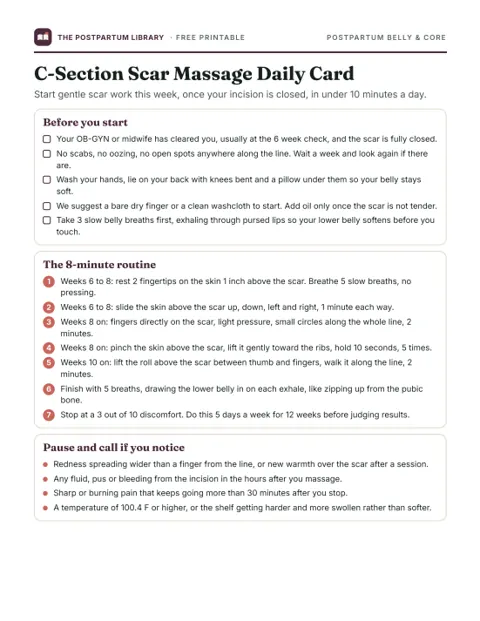
If you had a cesarean, the scar line holds the skin down at the incision while the tissue above it is loose. That's the overhang people call a C-section shelf. It's an apron with a fixed bottom edge.
What usually changes, and in what order: swelling goes down over the first few weeks. The uterus is back behind the pubic bone by about six weeks. The abdominal wall tightens over months as the deep core comes back and the gap narrows. Fat comes off slowly and from everywhere, not from the spot you want. Skin is last and slowest, and some laxity may not fully go away. Better to know that now than to blame yourself at month nine.
What moves each one
The fat parts, the fupa and the bulk of the apron, respond to the slow, boring things. Walking most days, starting with ten minutes and adding a few each week. Protein at every meal. Water, more than you think, especially nursing. Sleep when you can get it. Not under 1,800 calories a day if you're breastfeeding, and no crash diet at all; you lose milk and muscle before you lose the belly.
No exercise targets the mons or the lower belly fat. Anyone selling a "fupa workout" is selling.
The shelf, and how far the apron drops, responds to the deep core. Get cleared by your OB-GYN or midwife first. Then: lie on your back, knees bent, one hand on the lower belly. Inhale and let the ribs and belly widen. Exhale slowly through pursed lips and feel the pelvic floor lift and the low belly draw gently toward the spine, like the exhale is doing the work. Ten breaths, three times a day. After a couple of weeks of that, add heel slides, one leg at a time, eight to ten per side, keeping the belly flat on the exhale. No crunches, sit-ups, or planks in the first months; they push the wall out, not in.
Check your gap once a week. Lie down, lift your head an inch, press two fingers into the midline just above the navel, then below. Note how many finger-widths and whether the tissue feels firm or sinks. Write it down in the core tracker so you can see it shrink, because week to week you won't feel it.
If you leak, feel heaviness in the pelvis, have pain with sex, or the gap isn't closing by three to four months, ask for a pelvic floor physical therapist. That's what they do, and a referral is reasonable to request.
Now the skin under the apron, which nobody talks about. The crease stays warm and damp and it chafes. Pat it dry after showers, every time. Cotton underwear that comes up over the fold, not a waist trainer; a soft high-waisted brief is fine for comfort, a corset all day is not. If it gets red, raw, or smells, that's a rash that needs a provider, not more powder.
A bulge at the navel or along the scar that hurts, bleeding that soaks a pad an hour, fever, chest or calf pain, or thoughts of harming yourself or your baby: call your provider or 911. Those aren't belly questions.
If a year on, the fold still bothers you and the rest has settled, removing that skin is surgery, a panniculectomy, and a surgeon is the person to ask. It's a last step, not a first one.
Our guide, The 10-Minute Mom Pooch Reset, lays out the breathing and the first six weeks of deep core work in order.
The 10-Minute Mom Pooch Reset
The 12-week program for a stronger core and a firmer belly, 10 minutes a day, with gentle fitness from week 5.
See the plan →Not sure yet? Take the free 2-minute quiz
Educational content from The Postpartum Library. Not medical advice for your specific situation. Get clearance from your OB-GYN or midwife before exercising after birth, and see a pelvic floor physical therapist for leaking, pain or a bulge.