Severe isn't a diagnosis. It's the word you reach for when you press into your belly and your fingers keep going.
Nobody has an official cutoff for a severe diastasis recti. There's no guideline that says three fingers is moderate and four is severe. What people usually mean is one of three things: the gap is wide, the gap is deep and soft when you press into it, or the belly domes or cones up whenever you sit up, cough, or lift the baby. Those are different problems and they call for slightly different fixes, so it helps to know which one you've got.
If you haven't checked yet, or you checked and aren't sure what you felt, start with how to check for diastasis recti, because the test is easy to do badly.
Width, depth, and doming
Width is the number everyone fixates on. Lying on your back, knees bent, head lifted an inch, you press two fingers into the midline above your navel and count how many fit between the two muscle edges. One or two finger-widths in the first weeks is ordinary. Three or more, especially at or above the navel, is what most pelvic floor physical therapists would call wide and worth a proper assessment. Five or six is unusual but it happens, more often after twins, a big baby, or several pregnancies close together.
Here's the part that gets lost: width alone predicts very little about how you'll do. Say your fingers fit three across but stop about a knuckle deep against something that pushes back when you cough. That belly is in better shape than one where barely two fingers fit, but they sink to the second knuckle and you can feel your own heartbeat under them. Depth tells you how much tension the connective tissue (the linea alba) can hold. That tension is what you're rebuilding. The gap narrowing is a side effect of it, and sometimes it doesn't narrow much even when the belly works fine again.
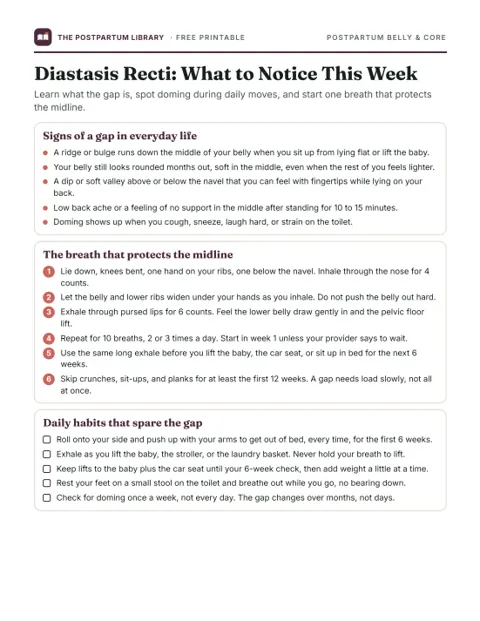
Doming is the third piece. If a ridge pops up along your midline every time you sit up to burp the baby at night or haul the stroller into the trunk, your deep core isn't managing the pressure, and every rep of that is a small load the tissue isn't ready for. That's the thing to fix first, before any exercise.
Now the one sentence that matters more than the rest of this post. If there's a bulge at or near your navel that hurts, gets hard, can't be pushed back in, or comes with nausea and vomiting, that is a possible hernia, not a diastasis, and you call your provider that day. Same for soaking a pad an hour, fever, chest or calf pain, or any thought of harming yourself or your baby: provider or 911, not the internet.
What a provider is actually checking
Your OB-GYN or midwife will likely do the same finger test you did, maybe measure with a tape or calipers, and feel for a hernia. Some will order an ultrasound to measure the distance in millimeters and look at the tissue itself. That's useful mostly when surgery is on the table or when a hernia can't be ruled out by hand.
Have your OB-GYN or midwife sign off before you begin any structured program, and while you're in the room, ask for a referral to a pelvic floor physical therapist. For a wide or deep gap this isn't optional in our view. A PT can tell you whether your tissue is generating tension, whether your pelvic floor is helping or fighting you, and which movements to hold off on. That matters double if you're also leaking, feeling heaviness in your pelvis, or having pain with sex, because those travel together more often than not. We wrote up what diastasis recti physical therapy involves so you know what to expect at the first visit.
Surgery exists. Plastic surgeons stitch the two edges back together, usually as part of an abdominoplasty. It's a real option for some women with a wide gap that stays loose after a solid year of rehab, who are done having children. It is not a first step, and most surgeons will want to see that you've done the work first anyway.
The work, in order
Breathing comes first, and we mean it literally. Lie on your back with your knees bent. Put one hand across the bottom of your ribcage and the other flat just below your navel. On the inhale, the hand on your ribs should move outward and the hand below your navel should rise a little; if only your chest lifts, the breath is too high. On the exhale, blow out slowly through narrowed lips so that the air takes about four seconds to leave, and pay attention to the lower hand. It should sink, and the area under it should firm up without you clenching anything. That firming starts low, down by the pubic bone, and travels upward toward the navel. Ten breaths, three times a day, for two weeks before anything else. Boring. Also the foundation.
Then you add the exhale to movement. Exhale as you roll to your side and push up to sit. Exhale as you unclip the car seat from its base. Exhale as you stand up from a low couch with the baby on you. If the belly domes during any of that, the load is too big for now, so make it smaller: hang the diaper bag on the stroller instead of your shoulder, change the baby on a table at hip height instead of the bed, and let someone else carry the water jug up the stairs.
Weeks three to eight or so, lying on your back: heel slides, bent-knee fallouts, single-leg marches with the other foot planted. Five to eight reps, slow, watching the midline. The rule for severe cases is simpler than for mild ones: if it domes, it's out, no exceptions, however good the exercise looks on someone else.
No crunches, sit-ups, or planks on the floor in the first months. No full-day binders either. A soft wrap for a couple of weeks after birth can make walking more comfortable, but it doesn't close anything, and worn all day it lets the muscles go quiet.
Walk every day. Eat protein at every meal, drink water, sleep in whatever shifts you can get. Tissue remodels on those, not on reps.
Progress is slow and uneven, and the finger count is a bad scoreboard. Depth and doming are better ones, and what before and after really looks like will keep your expectations where they should be. If you want to track it, our free core tracker logs width, depth, and what domed each week so you can show your PT instead of guessing.
If you'd like the breathing and early movements laid out as a daily routine, our guide The 10-Minute Mom Pooch Reset walks through them in order.

The 10-Minute Mom Pooch Reset
The 12-week program for a stronger core and a firmer belly, 10 minutes a day, with gentle fitness from week 5.
See the plan →Not sure yet? Take the free 2-minute quiz
Educational content from The Postpartum Library. Not medical advice for your specific situation. Get clearance from your OB-GYN or midwife before exercising after birth, and see a pelvic floor physical therapist for leaking, pain or a bulge.