The after photo is almost never one change. It's a stack of them, and the workout is one layer in the stack.
Say a friend sends you a pair taken six months apart. In the second one the fold over her lower belly is smaller and she credits a program. Between those two photos her uterus finished shrinking, she dropped the fluid she was carrying, she lost some fat from months of being on her feet at odd hours, her abdominal wall learned to hold tension again, and she probably stood in different light at a different hour. The program gets the credit for all of it.
That doesn't mean the workout did nothing. It means you should know which part it did, so you don't quit at week 4 because the fold is still there.
What the photos are showing
Sort any before and after into layers.
The uterus. For about 6 weeks it's still shrinking back down behind the pubic bone. A "before" taken in the first two weeks is partly a uterus, and the "after" gets credit for a change that would have happened in bed.
Fluid and bloat. Changes week to week and hour to hour. A morning photo and an evening photo of the same belly don't match.
The wall. The two halves of the rectus abdominis usually sit wider apart than before pregnancy, and the connective tissue between them is stretched. When that tissue can't hold tension, everything behind it pushes forward, the lower belly rounds out, and the fold has more to hang over. Training changes this. It's the part you control.
Fat. Pregnancy puts some of it under the skin of the lower belly, and the lower belly tends to be the last place it leaves. It comes off with the overall pattern of eating, sleep and movement over months, not from any exercise aimed at that spot.
Skin. If it stretched far or fast, or has stretch marks, some of it has lost elasticity and won't fully retract no matter what you do. It tightens somewhat over the first year, more for some people than others, and it looks better over a wall that holds. Past that, the options are living with it or surgery, and neither is a workout.
So when you look at a photo pair, ask: how far postpartum is each photo, what time of day, is she standing the same way, did she say what else changed. If the answers aren't there, the photo isn't telling you much.
The plan we'd follow
Before anything past walking and the breathing below, check with whoever delivered you, your OB-GYN or midwife, that you're cleared to exercise. Ask at the same visit for a pelvic floor physical therapy referral if you're leaking when you sneeze, if your pelvis feels like it's dragging by late afternoon, if sex hurts, or if the space between your abdominal muscles hasn't closed in by 12 weeks. One visit changes what you do at home. Stop and call your provider or 911 for soaking a pad an hour, fever, chest or calf pain, a bulge in the belly or near the scar that hurts, or any thoughts of harming yourself or your baby.
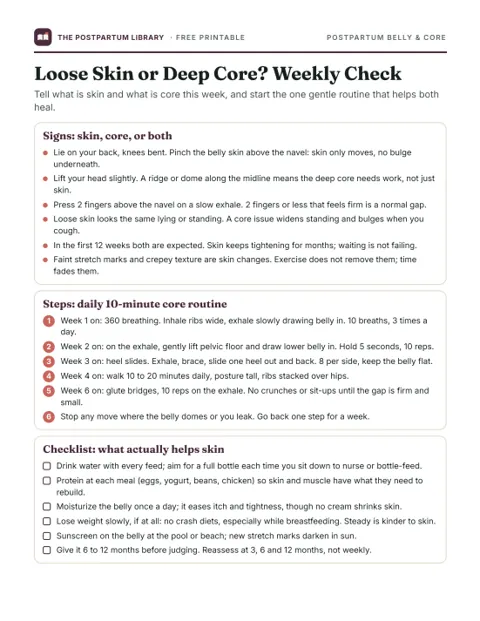
Weeks 1 to 6: breathing. Side-lying is easiest with a pillow between the knees, or on your back if that's comfortable. The inhale should go wide: put your hands on the lower ribs and aim the air at your palms and at the mattress under your back, so the rib cage spreads instead of the belly ballooning out front. Then a slow exhale, and on the way out notice the area below the navel flattening on its own and the pelvic floor closing and rising, the same effort you'd use to stop yourself from passing gas in a quiet room. It's a small movement. If you're straining or hollowing, you've overdone it. 10 breaths, three or four times a day, in bed is fine. If you had a cesarean, rest a hand over the dressing and keep the effort to a whisper. This is the actual start of the before and after, and nobody photographs it.
Add walking as soon as you're able, 5 or 10 minutes to start, a few more minutes every couple of days. For the fat layer in the early months, walking does more than anything else because you can do it every day with the baby on you.
Weeks 6 to 12: keep the breath work and add movement to it. Same exhale-and-draw, now with a knee fall-out (both knees bent, one knee lowers out to the side and returns, 8 each side), a march (one foot lifts an inch off the floor and sets down, 8 each side), a tabletop hold (both knees over the hips, held for 3 breaths, 5 holds), and a side-lying leg lift (bottom knee bent, top leg straight and lifting a few inches, 10 each side). Three rounds, about 12 minutes. The rule for every rep: if the belly domes up into a ridge down the middle, or you feel pressure or bulging at the pelvic floor, make it smaller or stop. Doming means the wall isn't holding yet, and that rep is working against you.
No crunches, no sit-ups, and no planks in these first months, nothing where the whole trunk is strung between your hands and your feet. That stretched midline is the thing you're teaching to hold, and a crunch asks it to carry a load it can't manage yet, so it bulges instead of bracing. Those moves come back later, and your gap will tell you when.
Weeks 12 and beyond: load. Standing up from the couch without your hands, exhaling on the way up. Lifting the baby out of the crib with the exhale-and-draw switched on. Wall push-ups, a loaded laundry basket carried up the stairs, a lunge onto a low step. Keep the doming check. Once you can hold hands and knees with both knees hovering an inch off the floor for 10 slow breaths with no doming, the wall has graduated. The fold may look about the same. That's expected. Keep going.
Eating: protein at every meal, water within reach all day, no crash diet. If you're breastfeeding, don't drop below 1,800 calories, and don't start cutting at all before 6 weeks. Fat loss that lasts is slow on purpose. Take sleep when it's offered, because the wall recovers while you sleep and appetite behaves better after it.
Skip the all-day waist trainer. A soft binder for a few hours after a cesarean can feel good, but anything worn all day presses down on a pelvic floor that's already strained and lets the wall go slack.
One practical thing nobody mentions: the waistband. Leggings that sit flat above the fold, not in the crease under it, stop the rubbing that makes you skip the walk. Raw skin under the apron makes you not want to move, and moving is the plan.
Taking your own before and after
Do it, and do it properly, because the mirror is unreliable and the scale mostly moves with water.
Same morning hour, before eating, same spot, same light, same shorts. Front and side, relaxed, not sucked in and not pushed out. Every 4 weeks, not daily. Daily photos only show you bloat.
Then record what the photo can't. Lie down, knees bent, lift your head just off the floor, and press two fingers above and below the navel. Note how many finger-widths fit, and whether the tissue underneath springs back against your fingers or gives way. Note the longest you can hold the exhale-and-draw while still breathing, and whether you leaked on a cough or sneeze that week. We built a free tracker for exactly this, with a spot for the photo and the numbers side by side: the core tracker.
What usually changes, and in what order: the fingers go from fitting loosely to fitting snugly, and the tissue firms up under them. Then the lower belly stops rounding forward when you stand, and the fold hangs from a flatter shelf. Then clothes sit differently around the hips. Fat comes off last and slowest. Skin changes slowest of all, and only partly.
If at 12 weeks you still have a wide, soft gap, leaking, or a heavy feeling by evening, that's the referral we mentioned, not a harder workout.
If you want the week-by-week version with the breath cues written out, our guide The 10-Minute Mom Pooch Reset lays it out in order.
The 10-Minute Mom Pooch Reset
The 12-week program for a stronger core and a firmer belly, 10 minutes a day, with gentle fitness from week 5.
See the plan →Not sure yet? Take the free 2-minute quiz
Educational content from The Postpartum Library. Not medical advice for your specific situation. Get clearance from your OB-GYN or midwife before exercising after birth, and see a pelvic floor physical therapist for leaking, pain or a bulge.